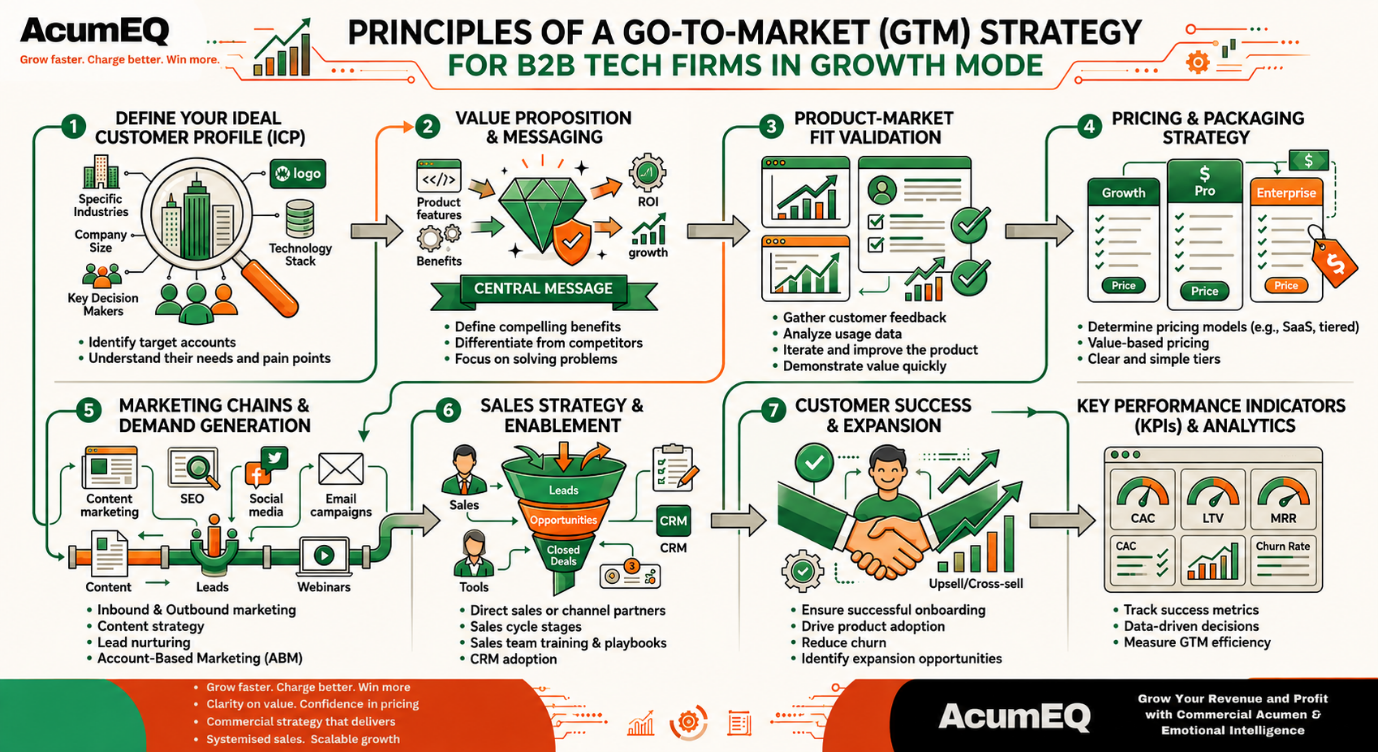
Many growing B2B technology businesses don't have a product problem. They have a Go-To-Market problem.
The signs are usually familiar:
- Plenty of conversations, but not enough sales.
- Revenue growth that feels unpredictable.
- Heavy reliance on the founder to close deals.
- Discounting becoming the norm.
- Marketing generating activity but not opportunities.
- Customers buying, but not expanding.
- Revenue growing faster than profit.
As businesses move from £1m to £50m revenue, what got them to this point often won't get them to the next stage. A strong Go-To-Market (GTM) strategy creates the commercial engine that turns market opportunity into predictable, scalable and profitable growth. The framework below highlights the key components.
1.Define Your Ideal Customer Profile (ICP)
The biggest mistake many growth-stage businesses make is trying to sell to everyone. A good GTM strategy starts with answering:
- Who gets the most value from our solution?
- Which customers are most profitable?
- Which sectors have the strongest urgency to buy?
- Who are the decision makers?
- What problems are they trying to solve?
Without a clear ICP:
- Marketing becomes generic
- Sales cycles become longer
- Conversion rates fall
- Resources get spread too thin
The best companies become increasingly focused as they grow.
Problems solved
- "We can sell to anyone."
- "We don't know where to focus."
- "Our pipeline is full but conversion is poor."
2.Create a Compelling Value Proposition
Many businesses can explain what they do. Far fewer can explain why customers should care. Too often messaging focuses on:
- Features
- Functionality
- Technology
- Company history
Customers don't buy features. They buy outcomes.
A strong value proposition clearly answers:
- What problem do we solve?
- Why does it matter?
- What is the cost of doing nothing?
- Why are we different?
The best messaging moves beyond product benefits and connects directly to commercial impact. For example, instead of "AI-powered workflow automation."
Try: "Reduce costs by 40% while improving compliance and customer experience."
Problems solved
- Prospects don't recognise the value.
- Conversations focus on price.
- Sales teams struggle to differentiate.
3.Validate Product-Market Fit
One of the most dangerous assumptions in business is: "Our customers want this."
Successful GTM strategies create continuous feedback loops. They listen to:
- Customers
- Lost opportunities
- Product usage data
- Sales teams
- Customer Success teams
The objective is simple: build more of what customers value. Build less of what they don't. Businesses that continuously refine their offer grow faster because they stay aligned with market needs.
Problem solved
- Growth has plateaued.
- Product adoption is weak.
- Customers are not seeing enough value.
4.Develop a Pricing and Packaging Strategy
Pricing is often the most underutilised growth lever. Many businesses inherit pricing structures that have evolved over time:
- Legacy customer deals
- Founder discounts
- Custom proposals
- Multiple exceptions
The result is complexity, margin erosion and inconsistent value capture.
A strong GTM strategy aligns:
- Customer value
- Commercial objectives
- Pricing architecture
- Packaging
Good pricing should:
- Make purchasing easier.
- Encourage upsell paths.
- Capture more value from customers who benefit most.
The objective is not simply to charge more. It is to charge appropriately for the value delivered.
Problem solved
- Excessive discounting.
- Low margins.
- Uncertainty around pricing.
- Revenue growing faster than profit.
5.Build Demand Generation Systems
Many growth businesses rely too heavily on connections or referrals. Referrals are valuable. They are not scalable.
A modern GTM strategy creates multiple demand channels:
- Content marketing
- SEO
- Email outreach
- Partnerships
- Events
- Webinars
- Account-based marketing
The goal is to create awareness long before a prospect enters a buying cycle. This is particularly important because most prospects are not actively buying today. They are simply becoming aware of a problem. Companies that consistently educate the market create future demand.
Problem solved
- Lead generation is inconsistent.
- Sales pipeline feels fragile.
- Revenue is difficult to forecast.
6.Enable Sales to Win More Deals
Even the best marketing strategy will fail if sales execution is weak. A strong GTM strategy creates a repeatable sales process. This includes:
- Qualification frameworks
- Discovery methodologies
- Sales playbooks
- Objection handling
- Proposal structures
- CRM discipline
The objective is to move from hero-selling to system-selling. When sales success depends on one founder or one star performer, growth becomes fragile. When success becomes repeatable, growth becomes scalable.
Problem solved
- Founder dependency.
- Inconsistent conversion rates.
- Long sales cycles.
- Poor forecasting.
7.Focus on Customer Success and Expansion
Winning a customer is only the start. The most valuable growth often comes from:
- Retention
- Expansion
- Cross-sell
- Upsell
- Referrals
A strong GTM strategy ensures customers achieve the outcomes they bought the solution for. This increases:
- Customer lifetime value
- Renewal rates
- Advocacy
- Enterprise value
Growth becomes significantly easier when existing customers become your best salespeople.
Problem solved
- High churn.
- Slow growth.
- Low customer lifetime value.
8.Measure What Matters
The final component of a successful GTM strategy is measurement. Without clear metrics, businesses often optimise the wrong activities. Key indicators might include:
- Customer Acquisition Cost (CAC)
- Lifetime Value (LTV)
- Conversion Rates
- Average Deal Size
- Gross Margin
- Revenue Retention
- Churn
- Pipeline Coverage
The objective is not more reporting. It is better decision-making. Metrics should help leaders identify where the commercial engine is working and where it needs attention.
Problem solved
- Decisions based on opinion rather than evidence.
- Lack of accountability.
- Difficulty understanding growth drivers.
Bringing It All Together
Many businesses treat these areas as separate initiatives. Marketing owns lead generation. Sales owns pipeline. Product owns development. Customer Success owns retention.
The reality is that growth happens when all these components work together.
A Go-To-Market strategy is not a marketing plan. It is the system that connects:
- The right customers
- with the right message
- through the right channels
- at the right price
- supported by the right sales process
- delivering the right customer outcomes.
When this happens, the symptoms that hold back many growth-stage businesses begin to disappear:
- Revenue becomes more predictable.
- Sales become less founder-dependent.
- Conversion rates improve.
- Pricing confidence increases.
- Margins improve.
- Customer value grows.
- Enterprise value increases.
The businesses that scale most successfully are rarely the ones with the best product. They are usually the ones with the strongest commercial engine behind it. And that is exactly what a well-designed Go-To-Market strategy is built to create.