Most growth conversations focus on tactics. More leads. Better conversion. New channels. Smarter pricing.
But profit growth doesn’t come from isolated improvements. It comes from a system.
After years working with B2B growth businesses, I’ve seen the same pattern repeat itself. Revenue feels volatile. Forecasts feel optimistic. Founders and sales teams are busy, but profits don’t move.
The issue is rarely effort. It’s almost always structure.
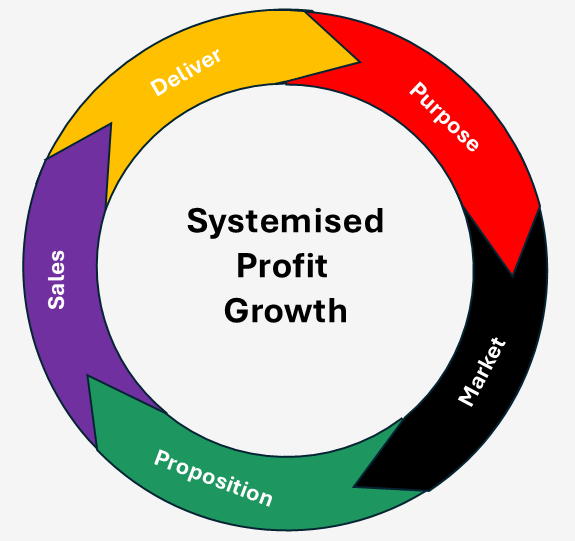
That’s why I use a five-stage Systemised Profit Growth model — designed to turn ambition into repeatable, scalable outcomes.
1.Purpose — Start with Direction, Not Tactics
Every system needs a reason to exist. Purpose isn’t a fluffy exercise. It’s the anchor that aligns decisions across pricing, product, sales and delivery. At this stage, we get brutally clear on:
- Why the business exists (beyond revenue)
- The problems and pains we choose to solve
- The outcomes customers actually value
- The financial goals that matter (profit, not just growth)
Without this clarity, everything downstream becomes noisy.
2.Market — Focus Beats Size
Most businesses don’t have a growth problem. They have a focus problem. Here we define:
- The real market opportunity (not the theoretical one)
- Clear ICPs and buyer avatars
- How customers buy and why they choose alternatives
- Where you genuinely differentiate
This step eliminates a scattergun approach to growth and replaces it with intent.
3.Proposition — Where Profit Is Designed
This is the engine room. Your proposition is not your product. It’s the value exchange between you and the customer. We systemise:
- Value propositions linked to outcomes and ROI
- Product and service packaging
- Brand positioning
- Cost and margin logic
- Pricing models that reflect value, not effort
Most margin leakage happens here, quietly and repeatedly.
4.Sales — Turn Activity into a System
Sales shouldn’t rely on heroic individuals. This stage focuses on building a repeatable commercial engine:
- Clear market hooks and messaging
- Channel strategy (social, events, partnerships, web)
- Proof points and commercial credibility
- CRM, signals, measures and qualification
- Structured negotiation and contracting
- Incentives aligned to profit, not just revenue
The goal is consistency, not charisma.
5.Delivery — Protect the Value You Sold
Profit is often lost after the deal is signed. Delivery must reinforce the promise, not erode it. That means:
- Standardised delivery models
- Strong customer relationships
- Disciplined change control
- Clear management reporting
- Balanced scorecards that track value, not just utilisation
Great delivery compounds trust. Poor delivery destroys margins.
The Loop Is the Point
This isn’t a linear checklist. It’s a closed loop system.
Each stage reinforces the next. Weakness in one area creates drag everywhere else. Strength across all five creates momentum and predictability.
If your growth feels harder than it should, the answer is rarely “try harder”. It’s usually: build a better system.
To see if the Profit Growth System will work for your business, book a free assessment call today.